According to the Guinness Book of Records, X-Men #1 is the highest-selling comic of all time. This was not a surprise, the X-Men were very popular and the comics speculation boom was in full bloom. This mass speculative was based on a fundamental misunderstanding of why things like Action Comics #1 were going for large sums. At the time they were seen as ephemeral, and so therefore when we come to 1991 surviving examples are rare. 1991's hot comics were being printed in their millions and purchased by a buying public that knew how to handle them properly. 23 years later, they're still not rare. They never will be, not in our lifetimes.
This is one of the least interesting things about this arc, though. It's Chris Claremont's last, for now. By now he had ceased plotting the books, and was doing dialogue, frustratedly. Some sniping is possibly apparent here in the "invisible spaceship" that is mentioned in the text.
Given its massive potential audience, what does it do? Does it take advantage of this to tell a compelling story while introducing the concept of the X-Men to a larger audience, like #1s try to do these days? Does it buggery. Yes, we've returned to the X-Men's default status quo, but within that we get a continuity-dense story resting on Magneto's brief time as a baby in 1977.
Today we would call that foolhardy, but in 1991 the book continued to sell, and would pick up readers. Was it a lost opportunity to get even more? Or is it that the modern rhetoric that comics are too hard to get in to does not really explain anything?
The story plays with the idea that the post-1977 Magneto is a different person to the pre-1977 one, because of a genetic alteration by Moira MacTaggert. She used him as an experimental testbed for a treatment for Proteus, her son. What she found was that the use of Magneto's powers made him mad, and what she did was a little tweak to his make-up to make this not a problem. Magneto's new group of Acolytes have found a variance, and Magneto is really quite pissed off at it. Crucial to the storyline's resolution, though, is the fact that this, if it ever worked, wore off (as his attempt at doing the same thing to Cyclops's team of X-Men also wears off, during their fight with Storm's team). Every decision Magneto has made has been his own, even the good ones.
The Magneto in this doesn't quite join up with the last time we'd seen him, in Uncanny #275. There, he looked like he was about to do something, here he's withdrawn and has to be drawn into action by the Acolytes. His interaction with Rogue carries on straight from that, though.
X-Men #1 is at once an odd comic to be the biggest-selling of all time, and yet also an obvious candidate. It had a superstar artist and writer, and is a #1 from the X-franchise. It's not great but neither is it interestingly flawed. It is the end of one era and the start of another (it will continue in publication until issue #275, making it I think the second longest-surviving bronze age comic series after Hellblazer). It is a perfect representation of what was going wrong and right with comics in the early 1990s. I have five.

Reading the X-Men from #1 to last week. Usually posts Thursdays.
Showing posts with label magneto. Show all posts
Showing posts with label magneto. Show all posts
Thursday, 13 March 2014

Tuesday, 4 March 2014
Uncanny X-Men #274-#277: All Hail the Chiefs
Uncanny X-Men #274 is, I think, the first issue to be narrated by Magneto. Having rescued Rogue in #269, he's gone to the Savage Land with her for a team-up with Ka-Zar and a show-down with Zaladane, who is using her magnetic powers in a way that might threaten the Earth. He encounters the mess of a much earlier expedition of his to the area, in the form of the Savage Land Mutates. Zaladane has also come to the attention of Nick Fury and SHIELD. Unusually they team up, despite the reservation of Colonel Semyanov, whose son was killed when Magneto destroyed the Leningrad
Magneto is introspective and moody in a way we've never quite seen before. The flashback to the firing squad is particularly effective - and will form a centrepoint of Pak's Magneto: Testament miniseries 17 years from now. He disassociates himself from his earlier "insane" actions, comparing them to Zaladane's now, but also is unable to apologise or take responsibility for them - the Leningrad did nuke him, yes, but he was blackmailing the world with demands to be made dictator. Another new wrinkle is Rogue's claim that Magneto hates Russians for the death of his daughter Anya, which is compared to Semyanov's vendetta. It unfolds unsurprisingly, Semyanov sells Magneto out to Zaladane, and then Fury/Magneto/Rogue win anyway. What is Magneto like in victory, though? Not, it turns out, magnanimous. Indeed, he declares his period of reform over: he needs to protect mutants (but without being a cackler himself), and says that a "kindler, gentler Magneto" cannot save them. He vamooses, presumably to take up villainry once more.
This arc introduces the idea of Rogneto. In a fairly creepy way, it has to be said, Magneto is perving on a Rogue who is not her usual self and clearly lacking in judgement (why are they killing people she asks, aren't they supposed to be the good guys? Uh No.) Thankfully the matter is dropped and then never referenced again.
In our other plot, for some convoluted reason the X-Men (Storm, Wolverine, Banshee Jubilee, Forge and Gambit) were teleported away from Earth by Lila Cheney to the eternal Shi'ar civil war. Deathbird is empress right now, and the rebels the Starjammers (Corsair, who just happens to be Cyclops's dad) are fighting to reinstate her sister Lilandra to her rightful place on the throne. If I were them I'd be trying to undermine the entire system of Imperial rule, but perhaps they are expecting plum ministerial positions under the new regime... at least until she gets turfed out again.) The war is not going well for Deathbird, largely because Lilandra's consort is a highly powerful telepath: Charles Xavier, who also happens to be the founder of the X-Men! But Xavier is possibly secretly evil and doing a bit of genocide on the side. Except then it turns out he is a Skrull, and so are the rest of the Starjammers! And they've got the real Xavier kidnapped! And then they free the real Xavier! And then they defeat the Skrulls! And then Lilandra and Deathbird actually do the "our division caused us to be weak against our enemies, let's make up" dance.
At the end, Storm infodumps enough of the disasters to have happened to the X-Men since Xavier left, and he learns of the rise of the Shadow King. Xavier agrees to come back with them, setting the stage for our next arc, Claremont's penultimate hurrah.
I believe this is the first intrusion of the Skrulls into the X-verse; certainly it's the first time I've written about them on the blog (apart from a passing reference to John the Skrull). The Skrulls are a race of alien shape-shifters originally introduced as villains in Fantastic Four #2. In that very first story a small advance party are brainwashed into thinking themselves cows. They go on to be frequent antagonists in Marvel: a Super-Skrull, Kl'rt, who combines the powers of the Fantastic Four, is introduced in FF #18 (it's this job that Xavin out of Runaways is training for), and fight the Kree, another alien race, in the pages of Avengers; and their latest invasion of Earth was the topic of the Secret Invasion crossover.
All these alien races were made up independently: the Skrulls in those very early days of the Marvel Silver Age; the Kree a bit later, in FF #65, and then the Shi'ar in the 1970s in these very pages. These, then are the Big Three Marvel Alien Species. Rather than anyone having sat down and worked this out, this is worldbuilding through crossover, things in a shared universe being patched together to form a galactic quilt. But that's just a larger-scale version of a continuity that allows Doctor Strange and Iron Man to co-exist; throw everything at a particularly sticky wall and watch it not going anywhere. Because... indeed, it's not going anywhere. It's rare for cosmic dynastic stories to have a point: it's just The Decline and Fall of the Roman Empire on repeat. If I wanted that, I'd just read Foundation again.
Magneto is introspective and moody in a way we've never quite seen before. The flashback to the firing squad is particularly effective - and will form a centrepoint of Pak's Magneto: Testament miniseries 17 years from now. He disassociates himself from his earlier "insane" actions, comparing them to Zaladane's now, but also is unable to apologise or take responsibility for them - the Leningrad did nuke him, yes, but he was blackmailing the world with demands to be made dictator. Another new wrinkle is Rogue's claim that Magneto hates Russians for the death of his daughter Anya, which is compared to Semyanov's vendetta. It unfolds unsurprisingly, Semyanov sells Magneto out to Zaladane, and then Fury/Magneto/Rogue win anyway. What is Magneto like in victory, though? Not, it turns out, magnanimous. Indeed, he declares his period of reform over: he needs to protect mutants (but without being a cackler himself), and says that a "kindler, gentler Magneto" cannot save them. He vamooses, presumably to take up villainry once more.
This arc introduces the idea of Rogneto. In a fairly creepy way, it has to be said, Magneto is perving on a Rogue who is not her usual self and clearly lacking in judgement (why are they killing people she asks, aren't they supposed to be the good guys? Uh No.) Thankfully the matter is dropped and then never referenced again.
In our other plot, for some convoluted reason the X-Men (Storm, Wolverine, Banshee Jubilee, Forge and Gambit) were teleported away from Earth by Lila Cheney to the eternal Shi'ar civil war. Deathbird is empress right now, and the rebels the Starjammers (Corsair, who just happens to be Cyclops's dad) are fighting to reinstate her sister Lilandra to her rightful place on the throne. If I were them I'd be trying to undermine the entire system of Imperial rule, but perhaps they are expecting plum ministerial positions under the new regime... at least until she gets turfed out again.) The war is not going well for Deathbird, largely because Lilandra's consort is a highly powerful telepath: Charles Xavier, who also happens to be the founder of the X-Men! But Xavier is possibly secretly evil and doing a bit of genocide on the side. Except then it turns out he is a Skrull, and so are the rest of the Starjammers! And they've got the real Xavier kidnapped! And then they free the real Xavier! And then they defeat the Skrulls! And then Lilandra and Deathbird actually do the "our division caused us to be weak against our enemies, let's make up" dance.
At the end, Storm infodumps enough of the disasters to have happened to the X-Men since Xavier left, and he learns of the rise of the Shadow King. Xavier agrees to come back with them, setting the stage for our next arc, Claremont's penultimate hurrah.
I believe this is the first intrusion of the Skrulls into the X-verse; certainly it's the first time I've written about them on the blog (apart from a passing reference to John the Skrull). The Skrulls are a race of alien shape-shifters originally introduced as villains in Fantastic Four #2. In that very first story a small advance party are brainwashed into thinking themselves cows. They go on to be frequent antagonists in Marvel: a Super-Skrull, Kl'rt, who combines the powers of the Fantastic Four, is introduced in FF #18 (it's this job that Xavin out of Runaways is training for), and fight the Kree, another alien race, in the pages of Avengers; and their latest invasion of Earth was the topic of the Secret Invasion crossover.
All these alien races were made up independently: the Skrulls in those very early days of the Marvel Silver Age; the Kree a bit later, in FF #65, and then the Shi'ar in the 1970s in these very pages. These, then are the Big Three Marvel Alien Species. Rather than anyone having sat down and worked this out, this is worldbuilding through crossover, things in a shared universe being patched together to form a galactic quilt. But that's just a larger-scale version of a continuity that allows Doctor Strange and Iron Man to co-exist; throw everything at a particularly sticky wall and watch it not going anywhere. Because... indeed, it's not going anywhere. It's rare for cosmic dynastic stories to have a point: it's just The Decline and Fall of the Roman Empire on repeat. If I wanted that, I'd just read Foundation again.
Tuesday, 11 February 2014
Uncanny X-Men #269: Rogue.split()
Uncanny X-Men #269 is Rogue's only appearance in a comic in 1990. When we last saw her, in #247, she was fighting Bastion, sacrificing herself to save everyone.
Cut to: Rogue waking up in that town in the Australian outback that the X-Men briefly hid in, and learning about the assassination of Mystique and the death of Destiny from the tellybox. I'm surprised at Rogue's naivity here: news involving Mystique should not be interpreted at face value, and although we as readers didn't see anything that contradicts the report, surely that's Mystique pretending to be Val Cooper...
This is another puzzling issue, featuring a fight with the original Ms. Marvel who seems to be being controlled by the Shadow King, guest appearance of the Muir Island X-Men, who appear to have gone bad, and, of all things, a cutaway to Lila Cheney, of the Shi'ar Imperium. And finally Magneto arrives in time to save Rogue... (What's he been up to, anyway?)
It also contains a good candidate for the X-Men's worst racefail yet. Rogue has occasion to nick powers off Gateway (discussed previously). As she does so, her skin colour changes. (No other aspect of her appearance, mind.) The? Please let this just have been a miscommunication with the colourist.
Cut to: Rogue waking up in that town in the Australian outback that the X-Men briefly hid in, and learning about the assassination of Mystique and the death of Destiny from the tellybox. I'm surprised at Rogue's naivity here: news involving Mystique should not be interpreted at face value, and although we as readers didn't see anything that contradicts the report, surely that's Mystique pretending to be Val Cooper...
This is another puzzling issue, featuring a fight with the original Ms. Marvel who seems to be being controlled by the Shadow King, guest appearance of the Muir Island X-Men, who appear to have gone bad, and, of all things, a cutaway to Lila Cheney, of the Shi'ar Imperium. And finally Magneto arrives in time to save Rogue... (What's he been up to, anyway?)
It also contains a good candidate for the X-Men's worst racefail yet. Rogue has occasion to nick powers off Gateway (discussed previously). As she does so, her skin colour changes. (No other aspect of her appearance, mind.) The? Please let this just have been a miscommunication with the colourist.
Thursday, 7 March 2013
New Mutants #74-#75: The Morning After The Nightmare Before
New Mutants #74 starts the morning after Inferno. New York is getting back to normal, after its collective trip. It's a lazy come-down Sunday, I hope; and the X-Terminators and New Mutants have bonded. The X-Terminators invite the Mutants around to their place. Ship is a bit skeptical about Warlock, but agrees after sufficient analysis that he's a mutant of his kind. Little Illyana is accepted as a latent mutant, but Ship takes a harsher attitude to Gosamyr, thinking she can't be trusted. Gosamyr agrees, and Ship provides another ship, to take Gosamyr somewhere where she might learn self-control.
Meanwhile, at the Hellfire Club, Magneto and Shaw argue, with bonus punching. Shaw blames Magneto for the events of Inferno, which on the one hand is a bit harsh (he never asked for the job). But I kind of see Shaw's point. Magneto has been weak and ineffectual: he was brought in so the Hellfire Club could work through him to form an alliance with the X-Men and the New Mutants; and now what?
The New Mutants have decided to abandon Magneto and possibly join X-Factor permanently, and so turn up at the mansion to give him his notice. Unfortunately, it's been destroyed, as we find out in #75. They rescue a survivor from the wreckage: Sabretooth, which is a bit of an unlucky catch for them. Soon enough the Inner Circle of the Hellfire Club turn up. Magneto's first wants to find out what's going on with Illyana. Given his previous experience as a baby it's no wonder he quickly accepts that she has become a 6-year-old.
Shaw continues angry, and him and Magneto continue their "discussion". Magneto makes all sorts of outlandish claims to try and get Shaw on side, like saying he was in charge of the X-Men (he really wasn't), and that the reformation was just an act and he had been plotting to use the New Mutants as minions. I'm not sure how much of this is nonsense he's making up on the spot, and how much is a real undermining of Magneto's purported change of heart. The discussion here is notable for being the first mention of Genosha in Magneto's presence : the fact that it is a mutant-based economy is taken as read by everyone.
Fighting comes to a standstill and the matter is decided by the votes of the White Queen and the Black Queen, who both stab Shaw in the back: Emma ostensibly because she'd disagreed with the Sentinels project (fair enough, but bit too late now!); and Selene because she wants a free hand in South America. Shaw flees, vowing revenge, and the club decide not to elect a new Black King. Instead, Magneto becomes Grey King, representing new morality (even though like the Black and White was nothing to do with that, but whatevs). It's hinted that he and Emma will seek to depose Selene eventually. Magneto then accepts the resignation of the New Mutants, wishes them well and hopes they will join him in the coming race war.
And cut.
RussWatch
Illyana says "Нет, мие зто ие иравится". Joe Rosen (or possibly whoever fed Joe the text) has made a mistake here: it should be "Нет, мне это не нравится" - i.e. he has substituted и (I) for н (n). This means "No, I don't like it". She also says "Меня зовут Illyana", which does indeed mean "My name is Illyana".
Sunday, 17 February 2013
New Mutants #67-#70: The Master of Magnetism
New Mutants #67 starts with Sam begging to be allowed to go attend one of Lila's gigs. He promises not to use his powers. This comic is getting really predictable now, and the relationship with Magneto is stultifying. For all that Simonson is Claremont's approved successor and all, she's not doing anything like what he did with the character. He's mostly just there as an authority figure.
In this, once the Mutants go AWOL again (to rescue Lila from space aliens, during with there is interpersonal drama and peril), he dresses in his classic red-and-purple duds (for the first time since Uncanny #199 - in 1985 - well unless you count X-Men vs. Avengers which so far Claremont hasn't acknowledged once), and visits the Hellfire Club for a special meeting regarding the Weird Shit that is happening all over the city as a lead-in to Inferno. There they call him "Magnus", which is I think the first sighting of that name in the present day? Shaw considers him to be a rather lax disciplinarian, which isn't exactly how I'd have imagined Magneto, but yeah, that's where he's at. He, like the government with its Mutant Registration Act, makes decrees that he can't possibly hope to enforce, and the Mutants have no reason to cooperate with.
If Xavier were around, he'd sack him.
Sunday, 3 February 2013
Classic X-Men #19: Magnetokinesisgenesis
Classic X-Men has already fleshed out the details of Magneto's origin story regarding Magda and Anya. But clearly, he didn't suit up in the red and purple immediately after that. There was an interlude, during which we saw him battle Nazis with Xavier. Something happened to finally flip him. What was it?
The backup in Classic X-Men #19 gives us our answer. The problem is: it's not very good. He was hunting Nazis on behalf of Mossad, only he hunts the wrong Nazis and the CIA get mad at him. They murder his loverdoctor Isabelle (note: the difference between Charles and Erik is that Xavier has sex with his patients but Magneto seduces his doctor), right in front of him, and then are surprised that he he's a little bit unhappy with that. He proclaims himself homo superior etc.
As I say, this doesn't work. It's a third personal tragedy for Magneto, but it pales in comparison to the other ones. Either he needs to go down that path through simple logic, or something with emotional resonance needs to happen to him. And fridging someone we've never met before just is not enough, not given his previous history. X-Men: First Class got this dead on.
Monday, 21 January 2013
Classic X-Men #12: Magneto: Not All Evil, Then
If I had to rank the things that Chris Claremont did for the X-Men in order, at number one would certainly be Magneto's backstory. Lots of stuff is written about the attempt to rehabilitate Magneto in the here-and-now: a little less about how Claremont has seamlessly worked in a set of motivations for his historic pattern of behaviour, and gave him a rivalry with Xavier that predates the start of the series. It's an integral part of who Magneto is now: they even made a film about it, eventually. A Magneto-without-the-holocaust is inconceivable now, even though it's becoming increasingly implausible chronologically. It's a rare thing indeed for a writer to come along 20 years later and do that to an already well-established and iconic character: it's as substantial a re-work as "The Anatomy Lesson".
Some people say they can discern elements of this in the Lee material: my colleagues at Children of the Atom say that Magneto and Xavier's telepathic battle in #4 is hinting at it. I can't agree, as Lee's run was simply not that subtle, and it wasn't shy of giving backstories when it wanted to: see the Juggernaut, Lucifer, and so on. But I will agree that Lee/Kirby's depiction of Magneto was certainly conducive to what Claremont later did. It worked out fabulously.
Let's see what we've had over the years.
| Issue | Backstory |
|---|---|
| X-Men #4 | Magneto rescued Quicksilver and Scarlet Witch from a mob in central Europe. |
| X-Men #125 | Magneto had a wife called Magda, whereabouts unknown. No mention of children. |
| Avengers #186 | A woman named Magda fled to Wundagore after her husband manifested powers and proclaimed his superiority to normal humans, where she gave birth to Quicksilver and Scarlet Witch. |
| Uncanny X-Men #150 | When Magneto manifested, he was avenging his and Magda's murdered daughter, Anya. He had been an inmate at Auschwitz. |
| Uncanny X-Men #199 | Magneto saved lives during the Holocaust. |
| New Mutants #49 | Magneto survived a firing squad that killed his parents, (by use of his magnetic powers?) |
This is all skillfully woven together in this in Classic X-Men #12. The framing story is set just after the events of X-Men #104, in which Magneto is not so much defeated by the X-Men as abandoned by them. Magneto recuperates in a hotel room, and remembers his life with Magda. They had escaped from Auschwitz soon before the war ended (dovetailing with the end of Magneto Testament), survived, and when the war was ended moved to Ukraine, with the idea that Magneto might go to university. Unfortunately, unscrupulous gangmasters kept taking commission and Magneto got angry. Crowbars were flung. Magnetokinetically. Oops. He then went back home, noticed his house was burning down, and is arrested while he would quite like to save his Anya, please. He lashed out, burning everyone, much to Magda's horror. She ran off, while he went on to become a mutant terrorist.
Except: in the present day, he's watching a house burning down with a mother and daughter inside.... He saves them. Not all evil then.
There's not much here we didn't already know, but it's still nice to actually see it happen, and the framing story sets up his later reformation. Yet, he's still going to act like a Silver Age villain for a few more encounters with the X-Men (in the reprints: he's already well on the wagon in the 1987-current comics). He needs time to work things out.
Friday, 18 January 2013
X-Men vs. Avengers: Magneto Was Right Here, A Moment Ago, I Swear
X-Men vs Avengers is a four-issue limited series written by Roger Stern and pencilled by Marc Silvestri. It is now almost impossible to Google. As the name suggests, the X-Men fight the Avengers, but while that might be the headlining attraction, it's not really what the story is about. Instead, it is a belated follow-up to the abandonment of Magneto's trial in Uncanny #200, and like the X-Men vs. the Fantastic Four limited series we covered last post, covers the reaction of the superhero community to his freedom and his association with the X-Men.
The U.S. government have set a trap for Magneto, by downing Asteroid M. Magneto finds out about this and immediately goes to recover what he can from it, and destroy the rest, lest it fall into the "wrong hands" (yes, he uses those exact words.) He is intercepted by both the Avengers, seeking to arrest him so he can stand trial again; and a Soviet super-team, who just want to see him dead in revenge for the attack in Varykino in Uncanny #150. There is lots of punching in various ways for the first three issues. The Interesting part of the plot starts with issue #4. The X-Men are placed into protective custody, while Magneto is hiding in Singapore. Magneto is contacted by a local group of mutants who acclaim him as a leader. Among them is a chap named Light who used his power of truth discernment to amass a fortune.
| X-Men |
|---|
| Storm • Dazzler • Havok • Magneto • Rogue • Wolverine |
| Avengers |
| Captain America • Black Knight • Captain Marvel • Dr. Druid • She-Hulk • Thor |
| Soviet Super-Soldiers |
| Vanguard • Crimson Commando • Darkstar • Titanium Man • Ursa Major |
Eventually Magneto surrenders and submits to a trial, but not without consulting Captain America about whether he should use his mass-prejudice-removal device on the entire world (which he cobbled together from bits of Asteroid M - now only practical that Xavier has left the planet). Cap says no, Magneto blasts him with it and is surprised to find his answer still the same. Cap never had been prejudiced against mutants.
This breaks Magneto a bit. It's time for his retrial (again with Haller defending and Jaspers prosecuting. The defence tries a new argument, that Magneto is a state actor in his own right, part of a new nation of mutants, and hence not bound by the Geneva Conventions. As an argument, I'm not sure this works: the Geneva Conventions are part of customary international law, but it's not like this comes up much. But if we're bringing the real world into it, it's far more likely that Magneto would be shipped to Cuba in an orange jumpsuit. The court rejects this argument, and then evidence is taken about Magneto's atrocities. Stern knows his stuff (he was editor for this part of Uncanny's run, after all) and the evidence here presented is a decent hatchet job on Magneto.
The court now retires to consider its verdict. Magneto is worried the ruling is going to go against him, and there will be an uprising by his Singaporean fan club and other such mutants. He'd really rather avoid that. Can the judges be trusted? One item of bizarre random paranoia is his belief that one of the judges is secretly a mutant and wishes to martyr Magneto precisely to start the race war, which mutants will win. Some investigation proves this false: the more prosaic and explanation is that that the judge is a mutophobe. Fortunately, Magneto's got an app for that.
Magneto gets let off: the revised non-bigoted judges accept his argument of lack of jurisdiction. It stops rather abruptly, as he leaves the court building he sees an angry crowd and wonders whether he didn't just make a terrible mistake. The idea that we can go back to business as usual (or rather, to Uncanny X-Men #220) after this is nonsensical, and I was almost expecting an issue #5, with the pogroms beginning.
The miniseries has to fit here because there's nowhere else for it to go: they just got Havok in #219 and then Storm goes off in #220. But it doesn't actually fit here. Apart from the difference in tone (apart from the scary ending, we'd simply not get something as Silver Age as a global anti-prejudice ray in the main series in 1987), we're seeing a different Magneto to the one we've been seing lately. Claremont's is just headmaster of the school and is kept at arms length from their other activities, whereas this one appears to be a fully-fledged member of the X-Men. Claremont's has reformed. This one just thinks he has. This Magneto has all sorts of wacky psychic powers that Magneto hasn't exhibited since Uncanny #4. Claremont's is the master of magnetism. I did this out of order (it's Christmas Eve, if you're wondering), and I can tell you that the Claremon/Simonson Magneto isn't going to put on that helmet for a good long time yet; whereas this Magneto doesn't even give it a second thought.
And yet, although he on paper he is examining a less well-developed Magneto, the ground this is covering is a far more interesting use of the character than the ineffectual sub-Xavier that Claremont/Simonson have him be at this bit in the run. That Magneto is never really tested, not until Inferno, at any rate. What are his limits? This title is willing to ask and answer that, and the answer, though less definite, is more convincing. And there's this idea of Magneto as a revolutionary hero to a mutant underground. Well, that's gonna have legs...
I originally wrote this post more or less as it appears above. Then I happened to look at the last few pages of the collection, that contained behind-the-scenes notes. And suddenly, it clicks into place why the last issue was so different to the others. Tom DeFalco wrote it, not Roger Stern. Stern's original treatment is presented: it presents a much less noble Magneto, still definitely wearing a black hat under that metal helmet. I said "Stern knows his stuff"; he only went and went through every single issue of any comic Magneto has ever been in and documented all crimes, however slight. He poured scorn on the rejuvenation defence, too. But this was not to be. Then, as 16 years later, Marvel would see value in a redeemable Magneto, but this time they caught it before it went to press.
Wednesday, 16 January 2013
New Mutants #53-#54: Pleased To Meet You
New Mutants #53-#54 is a two-part story set in one night. The gang have been grounded for weeks, Sunspot and Warlock have run away, and Magneto thinks he has just the idea to cheer them up: a party at the Hellfire Club, which the Hellions have also been invited.
This is not one of Magneto's better plans. And some of his have been real doozies.
It actually turns out surprisingly OK. Everyone gets little character moments. Wolfsbane and Catseye bond; Cannonball and Jetstream develop their rivalry; Magma discovers that Selene might be her ancestor (a distant very-great-grandmother - so I think we're supposed to believe that Selene actually is the Roman moon goddess at this point); Karma goes snooping for intel about her brother and sister; and Moonstar and Thunderbird face off about their respective teams. They end up in a challenge to find out who had sold a dodgy copy of a statue of Selene to a Hellfire club member; the Hellions win, by pointing the New Mutants at the early levels while the Hellions go straight to the boss fight. Sneaky.
Cypher and Roulette end up in bed together (after Cypher got lucky), where they are caught by the other New Mutants. This might possibly warrant adding them to the chart, except that the dialogue seems more pre-coital, so it will remain unadjusted.
And, while they were having all that fun, they've been basically driving off Karma, who has now left the team (again), on a quest to find Leong and Nga. According to the letters page in New Mutants #65, this was to have been a plot in Fallen Angels 2, which never did happen for various reasons...
Wednesday, 9 January 2013
New Mutants #52: Didn't This Book Used To Be Set In A School, Or Something?
The New Mutants are back at Westchester. They left during the Mutant Massacre to rescue Karma but then things have happened, and they've fought Magus, been to Limbo, met Robert the Bruce, seen two different futures, and encountered Professor X and the Starjammers. Although they've often only scraped through these adventures, this clearly puts them at a power level and competency that questions the premise.
So. Back at Westchester, and they are in the Danger Room with an extended sequence versus the Marauders. They lose badly, which conveniently nerfs them back to an appropriate power level for the format of the series: a bunch of students who get into japes despite the wishes of their teachers and escape by the skin of their teeth.
That's half the plot, anyway. The rest is Magik and Magneto. The comparison between the two is made a little blunter than usual: Magik has her demons to deal with (they're rebelling against her, and she dare not use the full extent of her power to put them down), and so does Magneto, as he points out. Except that his are metaphorical, and hers are literal. You see what he did there! Subtle.
So, that's about it. Nerfing and some characterisation. Will it work, though? The New Mutants have and done so much in the last few issues that going back to the school feels so... small. Coming back to my Buffy analogy, it feels like that scene of "The Body" where we're just following Dawn at school and she has no idea what's happening. After what has happened, you can't go back. You just can't. And there is still that outstanding question of Karma's brother and sister (Magneto assures her that he's doing what he can - presumably through the Hellfire Club).
In a reply to a letter, an announcement is made that Louise Simonson will be taking over New Mutants from #55 for a brief period while Chris Claremont takes a break to write a novel, "Firstflight" (Ace). I know the publication history: Claremont'll never come back, and eventually Rob Liefeld will start doing the art, and turn the series into X-Force. You can see the germ of it here.
Tuesday, 8 January 2013
New Mutants #51: Starjam
New Mutants #51 is more about the mentors than about the teens themselves. Our kids are still in space (after the events of #48-#50), and Xavier is deciding whether or not to return with them. He hoovers up memories: the Mutant Massacre is shocking, but not enough. The real surprise is seeing an advert for X-Factor on the tellybox: he recognises his original X-Men on screen.
Oh.
So, the main team really were just not paying attention: they only started noticing the adverts for X-Factor around the time of the Battle of Sheep Meadow. Maybe the kids just watch more TV?
Xavier decides to let go. The Starjammers need him and he can rely on Magneto. I suppose he must have done research on how that had been working out. One problem though: Magik is on strike. This is quickly worked round by Xavier ordering Karma to possess her and do it directly, something that is ruthless even for Professor X. Dani protests, so good on her.
Can Magneto be trusted? That's the question that Magneto himself has been pondering. He's got an offer to join the Hellfire Club as White King, and consults with Storm, who strongly urges he take it up. He doesn't, though - not on their terms anyway. Instead, Storm and Magneto join together, and wearing their own costumes. This is supposed to be an alliance, after all, not a supplication.
Friday, 28 December 2012
New Mutants #46-47: In Limbo
So, while the main team in Uncanny were out rescuing, the New Mutants were left with strict instructions to stay at the mansion.
They of course do no such thing, and by the end of Uncanny #212 they are missing, presumed incinerated. What happened to them?
Well, Karma tried to call her siblings at their Manhattan flat, and they didn't pick up. This is worrying. Magik and her check it out, only to be greeted by an exploding bomb (which is taken to by the Marauders, although I don't think there's any actual evidence). When they don't return, the other New Mutants go looking for them, via that Manhattan-Westchester tunnel. They go straight to Karma's, skipping any Morlock interludes, and find the fire brigade attending a burning apartment building and Xi'an and Illyana safe and sound. No sign of the younglings, though.
Then Warlock goes a bit crazy and Magus turns up, which is possibly not the best timing ever. Happily, there's a 'porter on the team, so they all wake up in Limbo. Wait, did I say happily?
This is possibly the longest extended time that the non-Russian members of gang have spent in Limbo, and it is not to their liking, especially as Bobby and Amara's elemental powers don't work very well there. And worse, they're not even safe: Magus breaks through the dimensional barrier, somehow. So they 'port randomly away again. This time to somewhere in Europe during the Scottish War of Indepenence, where they do the superhero fight-truce-teamup thing, only with Robert the Bruce. Which is at the very least novel.
Meanwhile back at the mansion (there should be an HTML entity for that, I have decided), Moira is worrying about the kids (particularly Rahne) still being missing, in between moments caring for injured X-Men and Morlocks. Magneto makes sure she eats properly, possibly the most leaderlike thing he's done in 23 years. But no action is taken by anyone. I suppose Cerebro isn't what it used to be.
Tuesday, 11 December 2012
New Mutants #38-#40: And They Woke Up And It Was All Real
New Mutants #38-#40 deals with the aftermath of Secret Wars II. The New Mutants were resurrected, but as soulless automatons, talking but not caring. Only Dani seems a bit more active, crying, and explaining what happened to Brightwind for us. Thor appears to her in a vision with a message of hope. As a frog. (Never mind Loki being a girl or a kid, Thor was a frog! Blame Walt Simonson.)
Magneto, now going by the name "Michael Xavier", Charles' cousin, isn't able to do much about this, and, after much consideration, takes Emma Frost up on her offer of taking the students off his hands. He closes down the school, with only Dani and Warlock refusing to leave. The X-Men are still in San Francisco, otherwise they'd surely put a stop to this.
I think we're supposed to reckon Emma is causing all this, especially once Empath is found lurking around the school grounds, using his powers to forcibly rpslash Sharon and Tom. At the Massachusetts Academy, we find out it is instead real damage from the Beyonder, as Empath simply can't work on them, and Emma fixes the kids at least part of the way.
Meanwhile, Magneto is wondering whether he did the right thing, Dani goes to visits her parents, and then Sharon and Tom turn up, almost dead, reporting what Empath did to them. Magneto decides that he'd been emotionally manipulated too, and sets off to rescue the kids.
Emma sees this coming, and via her local police force summons the Avengers, here consisting of Captain America, Wasp, Black Knight (Dane Whitman), Hercules, Namor and Captain Marvel (Monica Rambeau), and tells them the mutant terrorist Magneto is planning on abducting some of her students. In doing so, she sort of gives herself away to the Avengers, as they realise that the only reason Magneto might be interested in them is if they are mutants. Anyway, Avengers and Magneto fight, but the New Mutants - who have been partly fixed by Emma, show loyalty to Magneto and defend him. The Avengers are at least temporarily persuaded of his reform, and allow him to leave with the students. As does Frost - she knows she can't hold them against their will, and gets some brownie points for next round by not trying.
The story has a detached mood matching its subject material, and it's not immediately obvious what is happening or is motivating any of the characters. I'm not entirely convinced by the ending: but I guess Emma can't be as much as a hardass as we'd been led to believe.
Thursday, 29 November 2012
New Mutants #35: Radically Different Than The Old Boss
The New Mutants return from Asgard to the school only to find their new headmaster, Magneto, in charge in New Mutants #35. Well, I suppose he must have caught the flight back with them, only to have told them on arrival.
They are suspicious. Well, you would be, wouldn't you? Bobby points out that this isn't really any better than, say, Emma Frost taking over their tuition. And Magneto is really starting to wonder about what he's let himself in for.
Fortunately for him (but less so for Dani), he soon gets the opportunity to prove his worth to his charges. When Dani arrives back having nearly been assaulted (we don't really have to read between the lines to deduce that's it's an attempted rape), Magneto goes looking for the perpetrators, and here demonstrates the difference between him and Xavier.
Professor X would have mindwiped them, or something. Magneto just puts the fear of Magneto into them, and they decide that confessing to the police would be a really good idea.
This is some good character development: Magneto is protective of the children, which is entirely in line with his revelation in #150, but useless at management or leadership skills (he's been a solo villain since the break-up of the original Brotherhood in the 1960s, and he was a fairly imperious and ineffective leader of that). Here, he learns that he needs to be loyal for the kids for them to be loyal to him - an important step forward, which combined with his missing of Lee make him appear to be an actual rounded person. Please don't screw this up, Magnus. But I question the point of having a story with an attempted rape and then somehow making it all about a man. Can we not find something less gratuitous?
Wednesday, 28 November 2012
Uncanny X-Men #200: "The Trial of Magneto"
So. Trial of the century. It's all going on in
our special double-sized celebratory issue of
Uncanny X-Men #200.
Magneto is to be tried by an ad-hoc international criminal court akin to the Nuremburg trials. (I suppose the United States wasn't willing to hand him over directly the Soviet Union? Sadly, the claim that it is the first court of its kind would no longer hold up, because it has been necessary to set up special ad hoc international criminal tribunals for Rwanda, the former Yugoslavia and eventually a standing International Criminal Court was established. Americans: you really should get around to joining that one of these years, it's making you look ridiculous.)
Our impromptu tribunal is in Paris, rather than the Hague, presumably as reference images of the City of Light are a tad easier to come by.
For the prosecution, we have Sir James Jaspers, Attorney General of England and Wales. This is slightly weird - Attorney General doesn't have the same hands-on role in prosecutions as they do in the United States (that department is headed by the Director of Public Prosecutions), but it's at least true that he represents the British government at the ICJ, so we'll give it a pass.
More worrying is Magneto's defence team, which is the Ambassador of Israel to the United Kingdom, Gaby Haller, and Charles Xavier. Now, let's accept that Haller and Xavier have perfectly good in-story reasons for supporting Magneto right now. Nonetheless, what on Earth are they thinking. Were they not able to find an actual legal team? Does Xavier really want to be known in public not only as a "mutant-lover", but also as an actual Magneto apologist?
And worse than that: what is the Israeli government thinking? Is Haller acting in an official capacity? If they wanted to do an Israel-offers-mutants-asylum storyline, that would be pretty interesting, but that's really not what's going on, and instead it seems like Haller is going rogue. She gotta end up being sacked as a result of this, right?
To the the trial itself. Our first bit of business is the stuff prior to X-Men #104. The defence argues that that was a different Magneto, and that the current one can only be held responsible for actions after he has been restored to adulthood. Which might be true, but the court just accepts this assertion without questioning how it can be proven. The defence asserts that it's an established fact that Magneto went to Auschwitz, must therefore be in his 60s, and has clearly been de-aged since, and this all means he shouldn't be put on trial for stuff before he got turned into a baby. No evidence is presented of this remarkable claim. I don't know how this works - maybe they got Johnnie Cochran to give them pre-trial coaching? - but it does, and so the trial is confined mostly to the destruction of the Soviet ship Leningrad and the city of Varykino.
Magneto gladly 'fesses up to both of these, but doesn't see the problem. The Leningrad had just tried to nuke him, after all, and he destroyed the city in a relatively nice way.
Meanwhile, back at the mansion, tumbleweed sits down and starts singing about gold.
The X-Men and New Mutants are in Paris for this excitement, having been 'ported there by Loki following the shenanigans of New Mutants Special Edition #1/X-Men Annual #8. There are anti-mutant demonstrations and, very worryingly, someone is framing the X-Men for a series of terrorist attacks. But there's hope, too: the largest demonstration Paris has ever seen, in some kind of solidarity with our mutants. Maybe some of them say "Magneto avait raison"?
During all this, Xavier has been getting weaker and weaker. He's totally unprepared for the moment when the Strucker twins - the ones who had gone after Storm in Africa arrive, and become Fenris by touching their skin together. They are the children of the Strucker seen in the flashback in #162, and they want their revenge. There is fighting. Magneto stops Jaspers from killing one of the Struckers after they've been separated, which gets him points with the judge. More scuffling, and Xavier is injured beyond any normal human healing, but is fished out by the Starjammers using a stargate, for Sirpinksi to heal. Xavier's parting wish is for Magneto to take over the school and the X-Men, although he doesn't do so within earshot of anyone other than Magneto himself, which will lead to complications.
The trial is left in ruins. The defendant absconds, although since he's very shortly to be found at his defence attorney's country mansion running his school for gifted youngsters, it should hardly be a problem to track him down. And maybe he was about to be acquitted anyway?
And that's the first two hundred issues of X-Men. There have been line-up changes, there have been fake-outs. But never before has it done anything like this - sending Xavier away and having their former archenemy in charge. This is gonna be fun.
Monday, 26 November 2012
Uncanny X-Men #199: The Writing on the Wall
Mystique can see the writing on the wall: it reads "MUTIES". She's gone to Val Cooper and given herself and her Brotherhood up.
See, I'd read a summary of Uncanny X-Men #199, but
summaries are only good at saying what happened. They're
no good at pointing out what doesn't happen.
In this issue, what doesn't happen is that Mystique blows her cover identity - Raven Darkholme, assisant to Val Cooper. The incident is therefore much easier to read as Mystique being typically tricksy, and much less a shocking moment for her character than I had thought it would be. Having said that, the idea of Mystique-as-betrayer doesn't really exist yet, does it? She's just a perfectly ordinary evil shapeshifter, not a perfidious one.
Val Cooper agrees for an amnesty for Mystique's team - to be
renamed "Freedom Force" - if they are able to bring in the
Mutant Enemy No. 1: Joss Whedon. Er, no, I mean, Magneto.
Magneto, Lee Forrester and Kitty Pryde are at a holocaust event in New York. Kitty's great-aunt died in it, and Magneto himself, as we've discussed, is a survivor. Kitty wonders aloud about her great-aunt, and it just so happens that another set of Holocaust survivors attending had heard of her. Someone also recognises Magneto, and therefore presumably know his real name, or at least the one he was using in the 1940s, but at no point refer to him by it. Coincidence is just how superhero comics work, but I think it's worth a special mention here: this is woeful plotting for something which is trying to make a point out of how large in scale the Holocaust was.
So, while they're there, who should arrive on the scene but Freedom Force! Or rather, Lee Forrester reveals herself to be Mystique really. It's not entirely obvious when the switch was made: but it seems likely Mystique has been delaying the confrontation specifically to do it in the Holocaust museum, so that she can score some extra points.
There's a little bit of fighting (during which Pyro calls someone "cobber" - so he's Australian now, or possibly just Claremont doesn't clearly distinguish different types of Commonwealth slang), and ultimately Magneto realises he can't win and more to the point, shouldn't. He gracefully gives himself up for trial.
While this is all happening, Rachel Summers is visiting the Greys in Annandale-on-Hudson (well, creepily trespassing in their house, anyway). She finds the memory crystal thing that had been left there in #136, and laments the fact that she'll never
exist in this universe. Scott is about to has a child, certainly, but with Madelyne Pryor, and not her mother.
Oh, and she declares herself to be Phoenix, and makes herself a new costume. This will be awkward to explain to Scott, who still isn't aware of her connection with the Greys, and with him. There's something about Scott Summers and people not wanting to admit to his face about being his relative.
Friday, 23 November 2012
Uncanny X-Men #196: Welcome to the X-Men, Magneto
Some things happened in Secret Wars II 1, but I'm not going to read that miniseries, because it can't get any better than Luke Cage misunderstanding monetary theory and the Beyonder turning a building into gold (as my favourite comment on that post points out, he's not called BUYING POWER MAN).
So, let's look at our tie-in issue in isolation. Uncanny X-Men #196 starts with Dr Xavier (hrm, had it actually been confirmed he had a PhD beforehand?) lecturing at Columbia University, and getting the impression there's someone in this room who is intent on murder. Who, exactly, he doesn't know, because since he was mugged he's been taking telepathic-suppressant drugs (which he is, incidentally, lying about). He brings the X-Men to him (and Magneto and Lee), and asks them to go check on the various students.
Anti-mutant prejudice has reached the status of a moral panic. Our bad guys are turning on Kitty Pryde and declaring her to be a mutant just for being a student at the School (I guess the secret of what "gifted youngsters" is a euphemism for is out, then). Kitty loses the moral high ground by comparing mutie with her favourite shocking word, to someone's face, before then getting chloroformed, in the face. We then discover that the murder that the students were planning was... of Xavier! They've left a kind of mindbomb, which Xavier doesn't trigger on account of his drugs, but Rachel does.
That sends Rachel raging, and showing her hound-face to the other X-Men. She's ready enough to kill Phil and his gang, but Magneto, of all people, talks her out of it. Magneto's development here is rather sudden. Is this still all building out of the moment in #150 with Kitty, or is there other stuff that we're not privy to? I suppose the Lee Forrester stuff was working toward this.
Meanwhile, Nightcrawler is visiting Father Bowen, Marvel New York's go-to guy if you need a Catholic priest. He's Tandy's uncle (I think what's happened here is that Claremont has noticed there are two characters with the surname Bowen and then decided they should be related?), aided Karma and her siblings, and now now makes his first appearance in Uncanny, and now helps Nightcrawler deal with a crisis of faith. Kurt has been a believer ever since that Brood arc, and here we see what that actually means for him in a world of marvels and miracles. Is there a room for the Christian god when your team is on first-name terms with Thor?
It's been a while. Have a chart. This is an important one, as it marks the first interlinking of two previously separate groups.
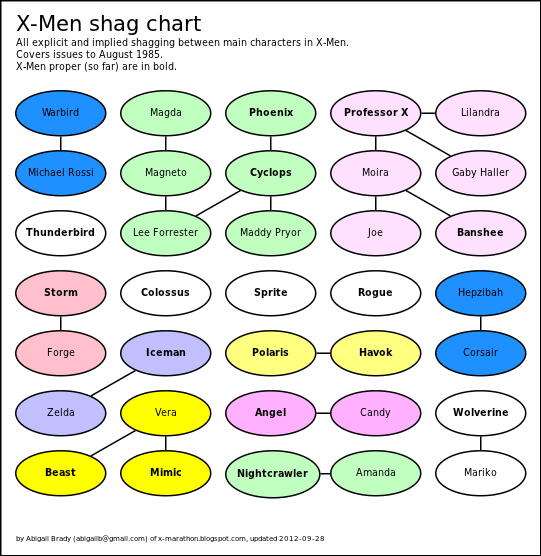
Sunday, 21 October 2012
Marvel Graphic Novel #5: God Loves, Man Kills
X-Men: God Loves, Man Kills is an X-Men graphic novel, released in late 1982. Unlike New Mutants, it is a standalone work, and until the re-appearance of its antagonist William Stryker in X-Treme X-Men, there was some doubt as to whether it was "canon".
I can sort of see how that arose: it has an anomalous chronological placement. The Chronology Project awkwardly puts it just before the last page of Uncanny X-Men #168 (it doesn't quite work as Kitty Pryde's codename is "Ariel" in this, but that's easier to overlook than the presence of Wolverine and Cyclops - tricky continuity is nothing new), so let's go with that here.
The basic story is that William Stryker, a former army sergeant, hates mutants (his child was one: he killed it and his wife). After a phase of drunkenness, he read an article by Xavier, got religion, and set up his own ministry: the Stryker Crusade.
Stryker is the latest in the line of humans who are afraid of mutants and want to wipe them out, but the first to do this without the aid of giant robots, and the first to be explicitly religiously motivated. There's a little bit of anti-evolutionary rhetoric in him, and he's the first person to ever ask why there are mutants, anyway? He plans to brainwash Xavier, and use his brain and a modified Cerebro as the instrument of destruction. He fills out Madison Square Gardens and gets a live TV broadcast of his finale, so the X-Men can't very well intervene. So they send Magneto to disrupt proceedings, who has less of a PR image to maintain, while they slip in the back.
Like Magneto's revelation in #150, the climax is someone threatening violence against young Pryde. In this case, though, Stryker shows no compassion, and has to be forcibly stopped from shooting her, by a cop. He'll be serving time for this.
The entire thing is dark and moody, both tonally and graphically. There's no Comics Code Authority logo on the front of this, and Claremont has taken full opportunity of it, by having Anne call someone a "bitch". Ah. This is where I should be talking about the use of the N-word, isn't it. I'm not sure there's much new for me to say. It is difficult to compare a madey-uppy slur like "mutie" with a real life word with a century or more of derogatory usage. It has something of the "Die Cis Scum" about it - in form it is abusive, but there's no real power behind it. It feels cheap, especially in something that's presenting itself a more classy "graphic novel". But the narrative doesn't pretend that Kitty didn't cross the line - Colossus immediately makes excuses for her. Because she was wrong.
Apart from the basic premise of Stryker and a copy of Cerebro, X2 also picks up on the temporary alliance of the X-Men and Magneto. This is the first time we've had this in the comics, and I don't think it quite works. Not Magneto's characterisation so much, but the way the X-Men just accept it. This is the first time we see them find out his name is "Magnus", or that he and Charles are "old friends". If X-Men really is a soap opera at this point, much drama could be made out of these things. And yet, nothing. This is mostly explicable by this being a graphic novel - it just wants to tell its story, not further the ongoing one.
I leave you with an exchange between Cyclops and Magneto.
            MAGNETO
      Contentment breeds tranquillity.
      Discontent, rebellion.  Therefore,
      I shall ensure the one by eliminating
      the root causes of the other: hunger,
      poverty, disease, war.

      The freedoms lost will not be noticed,
      even in the most libertarian of states.
      And the material benefits should more
      than balance the scales.

            CYCLOPS
      Anyone can create an utopia for a single
      generation, Magneto; the trick is making
      it last.  Who preserves your dream after
      you're gone?

            MAGNETO
      You, of course, Cyclops.  And the X-Men.
      Why do you think I want you by my side?
Saturday, 13 October 2012
Uncanny X-Man #161: Waiting for Gabrielle
This breaking news just in. Professor Charles Xavier is still in a coma. I'm a bit unfair, as Uncanny X-Men #161 actually advances this plot. We are told that "an alien consciousness has become part of him", and he's getting worse.
Moira says they've used another telepath to try and reach him - but he tried to use her as a means of suicide, which we've missed. Cyclops and Corsair are back from their visit to Havok and Polaris in New Mexico. Cyclops points at the complete botch that Storm made of the mission to infiltrate the Pentagon in #158, and suggests maybe he ought to be back in charge. Which seems reasonable enough, but he then backs down, ascribing it to the distress of Xavier being ill.
Xavier is remembering his visit to Haifa, in Israel, 20 years ago (so, 1962 at the time). He'd been there after his trip to Cairo (where he encountered his first evil mutant, we will remember, and a young Storm too). He's gone to meet his friend Daniel Sharon, who is working at a hospital with survivors of the holocaust. He meets a chap called Magnus there, who he can't mindread, and a young woman named Gabrielle Heller, who was at Dachau, who is not in a good way. He's able to telepathically deal with her block and get her conscious again. Soon enough she's doing all the tourist stuff with Magnus and Charles, and starting a thoroughly problematic relationship with Charles. Charles and Magnus start having hypothetical debates about mutants and what humanity's reaction to them would be. They do not, sadly, have comedy routines about keeping trousers up, even though Xavier should probably have kept his on.
Suddenly wild NazisHydra attack, and events force Magnus to reveal that he the power of manipulation of metallic objects and magnetic forces! Yes, he's Magneto! This all means that Xavier secretly knew Magneto before Uncanny X-Men #1! They rescue Gaby, who is being held in Kenya by Baron Strucker, and Magneto decides to "liberate" their stock of gold, proclaiming that mutants will fight for survival.
This will be our first major problem with the sliding timeline. You can fix Magneto's age a bit by the fact that he's been de-aged and re-aged, and Xavier gets a new body soon enough - so they can be biologically any age you please - but Xavier and Magneto meet as more-or-less contemporaries in a period where Holocaust survivors can be young women. And we can't age Heller too much, 'cos Xavier has a kid by her. Not that we know that yet, of course.
With that flashback out of the way, Xavier wakes up, and everyone is relieved. Lilandra, who has been sticking around, makes ready to leave, and invites them to space for a space banquet - Moira and Charles stay on the surface, as does Illyana. But then drama! Deathbird appears and assassinates Lilandra, and notes that the X-Men will be hosts for the brood-spawn!
Saturday, 6 October 2012
Uncanny X-Men #150: "I, Magneto"
Uncanny X-Men #150 is a special double-size issue, wherein momentous stuff happens and in which is made possibly the single greatest retcon in the history of comics. †
Magneto has set up shop on an island in the Bermuda Triangle that he's caused to be risen from the depths, and has taken Cyclops (Scott Summers), who has temporarily taken up being a fisherman, and his captain (Lee Forrester, who is a romantic interest for him) prisoner after they were shipwrecked.
Magneto tries to blackmail all the world's leaders (we get a nice selection here - Reagan, Thatcher, Brezhnev, Deng, King Abdul, and Moi) into making him King of the World. He wants to scrap the world defence budget (which he says is trillions - in real life that'd be a massive overestimate in 1981 - it's not even 2 trillion today. maybe he's including the Sentinels). Instead, he will lead H. sapiens to a glorious golden age, planning to eliminate "hunger, disease, poverty", damn the cost (hmm!), and providing Bobby Kennedy with a retort. He chews the fat with Scott, catches up on the news about Jean, expresses his sympathy, reveals that he has an inhibitor field which is shutting off Scott's optic blasts, casually destroys some nuclear warheads that have been launched at the island, destroys the Soviet submarine that had launched them, opens up a volcano in a fictional place out of Doctor Zhivago and threatens to do the same in Moscow.
The X-Men have finally got their finger out and started looking for Scott - they've tracked him and Lee to a shipwreck in the Bermuda Triangle and are looking for it alongside Dr. Corbeau (the X-Men's go-to man if they need a boat, it seems, as well as being the official provider of space shuttles), and a random Ms. Marvel (Carol Danvers), who might as well not be in this issue (except that she provides our first indication that Wolverine has a long and distinguished past in the superhero community - as he confirms that he used to work with her on special ops stuff).
We then get to the punching bit. They have to take down Magneto powerless, due to the inhibitor (which affects non-anatomy related powers - Kurt is still blue and has a tail, but can't 'port, Logan's claws still work but his senses are gone, and Peter shifts out of his steel form entering the zone). Can't work in these conditions, so they look to take it out.
It's a big issue for Storm - she has a moment to take down Magneto, but has sworn off killing people. She's there at the final confrontation with Magneto, where he comes close to killing Kitty, and then has a real change of heart, and well, let's quote it:
            MAGNETO
        She -- she is a child!

        What have I done?

        Why did you resist?  Why did you not understand?!
        Magda -- my beloved wife -- did not understand.
        When she saw me use my powers, she ran from me in
        terror.  It did not matter that I was defending her...

        ...that I was avenging our murdered daughter.

        I swore then that I would not rest 'til I had created
        a world where my kind -- mutants -- could live free
        and safe and unafraid.  Where such as you, little one,
        could be happy.

        Instead, I have slain you.

        I remember my own childhood - the gas chambers at
        Auschwitz, the guards joking as they herded my family
        to their death.  As our lives were nothing to them,
        so human lives became to me.

            STORM
          (arriving)
        Magneto!  Goddess -- no!

        If you have a deity, butcher, pray to it!

            MAGNETO
        As a boy, I believed.  As a boy, I turned my back
        on god forever.

        Kill me if you wish, wind-rider.  I will not stop you.

            STORM
        Is this some kind of trick?

            MAGNETO
        Yes.  Only it has been played on me.  I believed
        so much in my own personal vision, that I was prepared
        to pay any price, make any sacrifice to achieve it.
        But I forgot the innocents who would suffer in the
        process.  Can you not appreciate the irony, Ororo?

        In my zeal to remake the world, I have become much like
        those I have always hated and despised.
We learned about Magda running away in #125 and the contemporaneous Avengers #186, but most of this new information. Magneto's dialogue here is structured to pack as much punch as it can, by telling us what we know already and then, almost as an afterthought, revealing the new tidbit about a murdered daughte, and then going for the big thing. It must have been utterly shocking at the time for readers. This moustache-twirling villain has a motivation and not just one but two sets of personal tragedies (when Claremont comes to write Magneto's actual origin story six years from now, a third, less well-judged one will be added). Magneto is laid bare. How much of this does Storm actually overhear? Does Xavier find out about it? The idea that Magneto and Xavier are old friends is not yet present. These questions will never be answered: this is not treated as a dramatic revelation in-universe, and in fifty issues time it will be considered general knowledge.
This would seem to be Kitty's first Official Mission, although it's possible that she's stowed-away on this one, too. She's still in that multicoloured abomination of an outfit. As soon as she finds Scott, he sends her on a dangerous mission to mess up Magneto's computers, despite him realising that she's a child who really ought to be protected from that sort of thing. She succeeds, too, destroying a lot of his data (he should have had off-site backups!)
† other candidates in X-Men include the "Magneto/Professor X are old friends" bit, and my personal favourite "'Weapon X': It's pronounced 'ten'. Did we not mention that?" moment.
Subscribe to:
Posts (Atom)