Wolverine #48-#50 is a direct and immediate sequel to the Weapon X storyline in Marvel Comics Presents. It is predominantly set, real or imagined, in two Canadian locations: the Albertan facility that Weapon X was shown to operate in. He arrives at this in #4, more or less as we were expecting, along with keys left in his Lotus. He gets flashbacks, both to the actual events of the miniseries and to a strange buddy cop movie about him and Sabretooth, but doesn't investigate too far into the complex. The flashbacks continue into #49. Some of them are to a strange buddy cop movie starring him and Sabretooth.
I'm not even really kidding about it being a movie. In a warehouse in Detroit he finds the sets. For the buddy cop movie, for the incident with Silver Fox in #10, and for a variety of other locations. Logan's memories are contradictory. He remembers Sabretooth killing Silver Fox, he remembers the cabin they had; but he also remembers fighting her many decades later.
We know less about Wolverine at the end of this arc than we did at the beginning. We can't trust what we thought we did know. Neither can Logan. His few fragments have been shattered. He hopes the cabin was real - his first love was real, but if the evidence is simply not finding the set where it had been faked, ouch.
There's fighting. In his stealth-free recon Wolverine alerted Hines and the Professor to activate the "Shiva Project", which turns out to be a giant robot pretending to be Shiva the Destroyer. Not quite sure why that is, but hey. Shiva has a list of targets to elimate in order: Wolverine, Sabretooth, Fox, Kestrel, Vole, Mastodon and Wildcat. While that is happening, Silver Fox, who is leader of HYDRA, goes after Hines and the Professor, as revenge for the same thing happening to her. Eventually Fox kills the Professor, who sets the robot on the next target, Sabretooth.
This is all very puzzling. Silver Fox really did survive #10, which cheapens it and the Wolverine/Sabretooth feud. And if all these are false memories of Wolverine, why doesn't he remember them? What happened to make him break that conditioning in the first place? To make him leave that "Team X" (name still not yet given) and end up in Canadia working for Department H? Is there any larger sense to be made here or what?

Reading the X-Men from #1 to last week. Usually posts Thursdays.
Showing posts with label wolverine. Show all posts
Showing posts with label wolverine. Show all posts
Thursday, 10 April 2014

Monday, 7 April 2014
Marvel Comics Presents #72-#84: Weapon X
By 1991, Marvel Comics Presents had been headlined by Wolverine Team-Up stories for ages. The story that starts in #72, by Barry Windsor-Smith (I think he's the first person to auter the X-Men) is a rather different take. It is the story of How The Wolverine Got His Claws, finally.
Although this is a highly-serialised story (twelve parts), the trade paperback collection I am reading does not indicate the gaps. Structurally these group into four bits. There is a prologue, with Logan having been sacked from the Canadian army; he then gets used as a prop in a story in an unethical medical experiment. About half-way through, Logan escapes. Rather than the story following him, it becomes a slasher, instead, as our characters (Hines, the Professor, and Doctor Cornelius) are hunted down and killed; Logan then escapes. And finally, it's revealed that some of that was a simulation. Logan was loosed rather than escaping, and the trio are alive.
The beats were familiar, but some of the details of this story were surprising to me. We know that at this stage Wolverine's claws have no bone substrate, but the idea that they just sort of happened because of excess adamantium, and the housings designed to stop him hurting himself (or rather to stop him healing after them popping) is a bit silly. Given the lack of artifice in creating them, having them be coatings of bone claws make more sense! Further, the idea that the staff of Weapon X didn't know that Logan was a mutant also is a bit odd. But... presumably the shadowy figure that the Professor reports to does know that?
Much of this story is lies, of course. Apart from the bits it itself admits to (the escape), we know from later material that very little of this will stand. But that doesn't matter a bit. It's moody, it's tense, it's pacy, it's violent, it sets the stage for more Wolverine material and a thousand other inferior 1990s imitators.
This is not really Wolverine's origin story. It's not even pretending to be. What his birth name is, and what his childhood like isn't Wolverine's origin story, either. What led him to the state where he doesn't know if he has a mother, that matters. Why Sabretooth has a grudge against him, that matters. It'll be a while yet before we get to those, it's telling that those were left till last - it's not because they were least interesting, but because you could tell other stories revealing apparently quite profound bits of Logan's life while still retaining the Man of Mystery element.
But, as I say, that's later. Much later. If I ever get to it. For now, I want to know, what effect is this going to have on the Wolverine of 1991?
Although this is a highly-serialised story (twelve parts), the trade paperback collection I am reading does not indicate the gaps. Structurally these group into four bits. There is a prologue, with Logan having been sacked from the Canadian army; he then gets used as a prop in a story in an unethical medical experiment. About half-way through, Logan escapes. Rather than the story following him, it becomes a slasher, instead, as our characters (Hines, the Professor, and Doctor Cornelius) are hunted down and killed; Logan then escapes. And finally, it's revealed that some of that was a simulation. Logan was loosed rather than escaping, and the trio are alive.
The beats were familiar, but some of the details of this story were surprising to me. We know that at this stage Wolverine's claws have no bone substrate, but the idea that they just sort of happened because of excess adamantium, and the housings designed to stop him hurting himself (or rather to stop him healing after them popping) is a bit silly. Given the lack of artifice in creating them, having them be coatings of bone claws make more sense! Further, the idea that the staff of Weapon X didn't know that Logan was a mutant also is a bit odd. But... presumably the shadowy figure that the Professor reports to does know that?
Much of this story is lies, of course. Apart from the bits it itself admits to (the escape), we know from later material that very little of this will stand. But that doesn't matter a bit. It's moody, it's tense, it's pacy, it's violent, it sets the stage for more Wolverine material and a thousand other inferior 1990s imitators.
This is not really Wolverine's origin story. It's not even pretending to be. What his birth name is, and what his childhood like isn't Wolverine's origin story, either. What led him to the state where he doesn't know if he has a mother, that matters. Why Sabretooth has a grudge against him, that matters. It'll be a while yet before we get to those, it's telling that those were left till last - it's not because they were least interesting, but because you could tell other stories revealing apparently quite profound bits of Logan's life while still retaining the Man of Mystery element.
But, as I say, that's later. Much later. If I ever get to it. For now, I want to know, what effect is this going to have on the Wolverine of 1991?
Tuesday, 4 February 2014
Uncanny X-Men #268: When Logan met Steve
Uncanny X-Men #268 is an important step in development of Wolverine into the Logan we know today. It's The One Where It Turns Out He Knew Captain America from Back in the War.
The story itself is nothing remarkable - some fairly standard ninja fighting, but its use of two split timeframes - 1941 and 1990 - is rare. In 1941, Logan meets Cap in Madpripoor and they help Ivan Petrovich rescue a young Natasha Romanov from Nazis; in 1990 they (the three of them) fight the Hand. It's quite clever, and it's structuralist in a way that Claremont very rarely ever did. They all get on, obviously, although there's a nice bit at the end where Cap suggests that he and Wolverine make a nice team, and Wolverine is all "I don't have sidekicks". Burn.
Even though they've gone their separate ways, this story is part of a pattern of the X-Men become more well-integrated into the general superhero community - see the X-Men and Fantastic Four becoming besties in Days of Future Present for example. Their period of isolation is ending. The 1990s is beginning, the age of the crossover.
The story itself is nothing remarkable - some fairly standard ninja fighting, but its use of two split timeframes - 1941 and 1990 - is rare. In 1941, Logan meets Cap in Madpripoor and they help Ivan Petrovich rescue a young Natasha Romanov from Nazis; in 1990 they (the three of them) fight the Hand. It's quite clever, and it's structuralist in a way that Claremont very rarely ever did. They all get on, obviously, although there's a nice bit at the end where Cap suggests that he and Wolverine make a nice team, and Wolverine is all "I don't have sidekicks". Burn.
Even though they've gone their separate ways, this story is part of a pattern of the X-Men become more well-integrated into the general superhero community - see the X-Men and Fantastic Four becoming besties in Days of Future Present for example. Their period of isolation is ending. The 1990s is beginning, the age of the crossover.
Wednesday, 3 April 2013
Uncanny X-Men #256-#258: Lady Yellowface
Going by the cover dates Uncanny X-Men #256-#258 contains the first issue of the 1990s. And as if they already know what the decade is going to be like, the first thing they do is make one of their characters into a bloody ninja.
So.
The Mandarin. He's primarily an Iron Man villain, and he's going to be played by Ben Kingsley in this film that's coming out later this month. Do I need to go into his name? Mandarin is a word in English that originally referred to Chinese imperial bureaucrats. In this sense it has a bit of a perjorative usage. Because of this, it also the name used in English for the standard spoken Chinese used by the Chinese government, and also that of the northern varieties of Chinese spoken in the north. In both senses it is an exonym: a word applied to a group by others. Do you imagine Stan Lee knew any of this in 1964 when he invented the character? Of course not. Why then do I bring it up now? Because hey, it is the 1990s, and people really ought to be thinking.
So.
The Mandarin. Hong Kong. They tried to book Madripoor, but it was in use by a Wolverine storyline. OK, so can we get Wolverine? Psylocke. Mojo. Ninja brainwashing. Obviously ninjas have to be East Asian. Skin colour. Epicanthic folds, installed on a face hidden behind a mask. Psylocke becomes "Lady Mandarin", Mandarin's chief enforcer. Wolverine and Jubilee arrive on a boat; Wolverine disguises himself as "Patch", which worries Mandarin, and Psylocke is sent to deal with him. When the mask is revealed Wolverine recognises her. It's her face, just changed a bit for the 1990s. Psylocke takes a rare look inside Wolverine's head (and sees the Nick Fury and Carol Danvers inside there), a sight so shocking it breaks the conditioning.
The body transformation thing is just dropped in there as a minor detail. Well, beyond the Mojo-y dream sequence thing which reads awfully like bad transformation fic. I find it hard to believe this got published in a Code comic as far ago as 1989, before comics had really given up on the teenage market; but there it is, in front of me, in four (or more) colours. The colourist is told to draw her skin one shade darker. Betty doesn't even really acknowledge what happened to her physically, the real problem is the brainwashing. Lots of things will go back at look at the corporeal aspects. For now, the Japanification is just there as a fetish element.
And that's why it's - without question - problematic. If you had the exact same story elements used differently in a story that was actually about race, then could one make a case that it was worthwhile. That's not happened. It's a gimmick.
Still, we've not had much post-Lady Mandarin Psylocke to deal with yet; perhaps there will be some thoughtful consideration of identity (you'll note that in addition to having her appearance taken from her, she remains in the swimsuit with ribbons that she was assigned in this storyline - her codename had come from Mojo, too, back in the day) And she can compare notes with Sharon and Tom, who had a similar experience. But this story isn't it.
Saturday, 30 March 2013
Marvel Comics Presents #38-#50
Marvel Comics Presents ran a Wolverine feature from issues #38 to #47, named "Black Shadow, White Shadow". This was written by Marv Wolfman and drawn by John Buscema. It offers a fairly simple story about monochromatic monsters that turn out to be manifestations of some guy's mind, and emphasises the idea of Wolverine as a someone who is by temperament a family man, but has been prevented from such from fate and his own decisions. I like how Logan starts wearing the Wolverine costume half-way through, and people call him "Patch" (with scare quotes, in dialogue).
#48-#50 runs another story, "Life's End", by Erik Larsen. This is one of the first Wolverine/Spider-Man team-up stories (the first was I believe Marvel Team-Up #117 from 1982). It's a combination that will later form (with Luke Cage) the core of the New Avengers, and I kind of like their chemistry here. The comedy aspect might be a bit too much for some, though: the story is a fairly simple team up to defeat a villain, but with added fourth-wall breaking. In particular: Spider-Man has become aware of how amazingly improbable his life is, and how all his supervillains turn out to be people that Peter Parker happens to know, even though so far as he knows his secret ID is solid. What gives? Having set this up, it then delivers a payoff by having one of the minions of Critical Mass be... Peter Parker's... dentist. Hah. Well-played, Mr. Larsen. Well-played.
Wednesday, 27 March 2013
Uncanny X-Men #251-#252: Needlessly Messianic
Uncanny X-Men #251-#252 sees the X-Men reduced even further: to Wolverine and Jubilee.
Wolverine was out when the Reavers originally came, and they've since watched a variety of supervillain attacks on the X-Men do some severe damage. They'd better move soon, before it's too late.
Wolverine arrives back to find the team gone through the Siege Perilous. He is tortured by the Reavers, and nailed to a cross (a saltire, of course). They make the very basic mistake of leaving him for dead, something you should never do to people you are crucifying, and certainly not to Wolverine. Wolverine and Jubilee (finally revealing herself, and proving herself to be a regular Valley Girl in her dialogue) team up and escape.
So Uncanny X-Men lasted as a team title for 26 years, from 1963 to 1989, when, after a series of disastrous reorganisations it ended. Odd coincidence of timing, that. Circumstances are different, though: Uncanny is doing a provocative move at the height of its popularity. And other books are busy doing the X-Men team thing better than Uncanny has been for a while: it'll be good to see what this series is like removed from the shackles of the team structure.
Wednesday, 20 March 2013
Wolverine #10: What Day Is Today? It's Logan's Birthday!
Wolverine #10 is a rather important issue, and kicks off what I will call the second phase of his development. In the first phase, he grew as a character, but his backstory remained mostly a blank book, other than that he seems to know everyone and everywhere. (Clearly Wolverine is a networker as well as a multitasker.)
Now we start to look at that history through the gloom of hazily-remembered flashbacks, as we find out that Wolverine isn't just some generic man of mystery, but actually cannot remember his past (if you know your Logan you'll be able to take a good guess where I'm going to declare the third phase of Wolverine to start). In this issue, Wolverine is in Madripoor, still going by the name of Patch (natch). He is attacked by some people on his birthday, and as he defends himself and his friends from them, he is surprised to find them turning up dead. He knows why when he gets back to base, to find a letter proclaiming that nobody kills him (especially not today), apart from the writer, Sabretooth.
This Wolverine/Sabretooth rivalry occupied a few pages of Uncanny's Mutant Massacre issues. As I wrote there:
In those two pages (issue #212 13-14), everything we need to know about their pre-existing relationship is lain in front of us. They're rivals, but Sabretooth thinks Wolverine is beneath him.
I stand by that. Those pages were a manifesto for the Wolverine/Sabretooth dynamic, which sprang unusually clearly right from that first appearance. If it were anyone other than Claremont I'd say it was surprising that it took so long to explore it. But... it's Claremont. He still hasn't explained the Mystique/Nightcrawler connection and that's been seven years. So by that standard, this is quite hasty.
Many years ago, we are shown in flashback, Sabretooth killed Wolverine's lover, Silver Fox. No particular motive is shown to us other than sadism, we don't even have the context of knowing when this took place (we know it's before he's been implanted with adamantium bones, and he doesn't have any claws), or anything about Silver Fox. In one way, she's just one of the many people Wolverine has known who has ended up dead (this time before we even met Wolverine).
But she's more than that: she's his first lover. Wolverine has always been - and make sure you're not drinking when you read this as I will not take responsibility for drowned keyboards - a figure with a touch of asexuality about him. And I don't mean that he reproduces asexually. He makes a show of lusting after Jean (Inferno has emphasised this), but back around 1980 he was more a soppy romantic - he picked up flowers for Jean in #101. His admiration for Mariko has been a little self-denying. And yes, I link him and Yukio on the roof; but let's remember the context here - Yukio was lusting after him and he was sating her so as to keep her onside. The man, to put in in a nutshell, fucks. Animalistically. But he has fuck-buddies, not lovers.
So for us to finally hear of an old lover of Wolverine. Someone he had given his heart to, only for it to be ripped out. Well, that makes sense of his gingerness around Jean and Mariko, then. As to Sabretooth? Well, we don't know much more about him and Logan than we did already. But I will note that his repeated use of "runt" implies a familial relationship, to me at least.
Friday, 15 March 2013
Wolverine #9: Iraq
Wolverine #9 is by Peter David and Gene Colan. This makes David the first person other than Claremont to script solo Wolverine. It's a pared back story, told mostly in flashback, about a Logan (in blue-and-yellow costume) who took revenge on some mercenaries for driving a nun to despair during a hostage crisis.
This is minimal enough that it is difficult to even call it a character study, but it certainly considers how Wolverine has changed over the years: he himself doesn't think he'd do that sort of thing today. And it's true, he has undergone an enormous transformation from his introduction in #181 as a Hulk antagonist who didn't play well with with others, to his appearance in #7-#8 as a man who is an essential part of the X-Men, has his own supporting cast, and can manipulate a Hulk into doing good.
That was the first phase of Wolverine development: 1974-1989. Now it's time for the second act.
Wednesday, 27 February 2013
Wolverine #4-#8: What Immortal Hand or Eye
Wolverine #4-#6 continues immediately from that first arc for Jessica Drew and Lindsay McCabe, but Wolverine's chronology at the MCP places Uncanny #232 though to #243 - including all of Inferno between the issues. Apparently they've just been hanging around there for weeks waiting for Patch to get back? There's a long rationale for it, which brings in non X-Men books, so I don't care, I'm doing it now.
The story opens with the by-now familiar trope of an old friend of Logan's, who we've never heard of before, and is generally either dead already or is killed in the first few pages. Teebore identifies it here as starting with Asano in the Claremont/Miller miniseries. There's a structural reason it has become so commonplace in the Claremont/Buscema run already, and that's the tension between the attractive idea of Wolverine's backstory being explored by meeting old friends, and the narrative's need to keep his identity quiet. If the X-Men hadn't have been in hiding and presumed dead when Wolverine's solo title launched, there'd be no need for all these people to die. And then he'd be able to actually use the name "Wolverine" in a series called that.
Our old friend this time is Chancellor Ranjamaryam, an advisor to the prince, who is killed because he is sympathetic to Tiger Tyger's burgeoning new crime empire. When this comes to Wolverine's attention he decides to look into the matter himself. He'd had dinner that night with a person with a smell he's sure he recognised: Karma.
Karma hasn't been seen since New Mutants #54; where she'd left to look for her brother and sister. Logan confronts her alone without letting on who he is. She misses the opportunity to explain what had motivated her to work for her crimelord uncle again. (Logan would surely have added it to his TODO list). Nyugen Ngoc Coy is planning on making a play to be Kingpin of Madripoor (after having been ejected from San Francisco), with the connivance of the prince now that Ranj has been removed and a couple of new entries for Wolverine's rogues gallery: Roughouse and and Bloodscream.
Logan is still not exactly an enthusiastic supporter of Tyger Tiger, but she's cracked right down on the slavery and the drugs, whereas Nyugen has no such compunctions. Logan takes a typically direct approach, by going to the appropriate section of the Golden Triangle (real), and destroying a very large amount of Nguyen's heroin, with the help of Archie Corrigan (a potential traitor), which will put him out of action for a bit.
Meanwhile, an injured Tyger Tiger (she survives an attack by Nyugen's minions thanks to sabotage from Karma) and the Drew/McCabe team seek refuge at Landau, Luckman & Lake, and the mysterious Mr. Chang. This bit is very curious: it appears Chang is acting as a supplier for the X-Men, as he is able to supply a metal battlesuit like the sort we've seen Psylocke wear, being held for Logan. And they notice a tintype (misspelled tinytype here) photograph of Logan with Mr. Chang, which they date to the 19th century, implying a Logan who is as old - if not older - as the one ultimately revealed by Origin. The inquisition is cut short, though, by some fighting, which kills Mr. Chang and leaves the building in rubble.
Issue #6 is a massive fight scene between the parties (the captured three, Patch, Karma, and Nyugen's henchman). This is stopped by the Prince, who had (a) wanted a quick coup, none of this messiness, and (b) turns out to be a Lindsay McCabe fanboy. A compromise is reached. This is very sudden and I detect an editorial hand behind the pages. We then progress, for #7-#8 into a fairly throwaway story with Mr. Fixit (aka the Hulk: at this point he is grey, intelligent, and only comes out at the night), who has been sent to assist? Nyugen but ends up being suckered by Patch into destroying his operation.
Monday, 25 February 2013
Uncanny X-Men #235-#238: Holiday in Genosha
Uncanny X-Men #235-#238 is a ridiculous retcon that shouldn't work. We are supposed to imagine that there has been a highly-advanced nation, Genosha, built on mutant enslavement, all along, and that nobody mentioned this until now (its existence is outright contradicted by dialogue in #200 which explicitly mentioned systemic oppression of mutants as a theoretical thing rather than something happening in the world right now.)
But, actually, I don't care. Genosha is a fantastic idea, and yes, it would have been better if Claremont had written it in a hundred issues ago, or even if Stan Lee had written it into #4 as the nation that Magneto was overthrowing, or whatever. But that didn't happen, and it's only now (possibly to provide an example of what Mutant Registration could lead to if the government tries to enforce it).
So, what exactly is going on in Genosha, anyway? Well, we're told it is an island country north of Madagascar, and that it owes its wealth - which supports a first-world lifestyle for "ten million" people - to the results of slavery of a "few hundred" mutants. This is seems like unfortunately broken worldbuilding. Mutants should be really very rare, and yet we see them randomly in city scenes. You wouldn't waste one by using their extra-long limbs to pick up garbage, for example. And there would be no need for mutant-only railway platforms. Still, it's a very powerful idea, and it can withstand the details now being quite right yet. The enforcers are called Magistrates, and the chief of their number a woman named Anderson, in what I take to be another Dredd reference.
We're also told - in an attempt to justify why it had never been mentioned in the more than 300 other X comics that - that they have been able to keep the oppression secret, despite open segregation on the streets, and despite the country sending "Press Gangs" abroad to abduct people. Fine, whatever. Just get on with it.
Apart from the concept, there is some character work for some of our team who had been stuck in a rut. Wolverine admits that his claws kinda rely on his healing powers to not kill him: when he is depowered he starts to die (possibly from adamantium poisoning although I don't think that's made explicit). Rogue, when depowered, takes on the persona of Carol Danvers. Together, the two of them, as Ace and Patch, take a tour of Genosha and expose its nature to the Genegineer's son. He and his girlfriend - whose extrajudicial extradition had been the proximate reason for the X-Men getting involved - leave with the X-Men. Wolverine threatens that Genosha had better get its shit together, or they'll blow the entire thing sky high.
The fact that enslaving a few hundred mutants can result in such a boost to a country's economy - and we're not talking a tiny little island nation here, but talking something with the population of Portugal - implies that similarly powered mutants in less segregationist parts of the world would be able to get a very good wage, which is a curious result. Mutant dominance of the world could be economic dominance?
Sunday, 24 February 2013
Wolverine #1-#3: Multitasking Is My Mutant Power
Wolverine #1-#3 is much stronger than the Marvel Comics Presents Wolverine story. That had somehow ended up feeling like a generic Wolverine-in-Madripoor story, even though it was the very first one. This is another Wolverine-in-Madripoor story, but despite being an immediate follow-up is a little more distinctive, as his worlds collide.
Wolverine is in Madripoor on Wolverine-in-Japan-related business travel. There's a talisman being couriered to Mariko, and someone had murdered an entire 747 of people to get information about it. Wolverine has revenge to take, and people to protect.
Problem is the courier is Lindsay McCabe, Jessica Drew/Spider-Woman's business partner, who knows him as Wolverine. And he doesn't want to break the "X-Men are dead" line. So he wears and eyepatch and calls himself Patch. What he doesn't do is skip the morning hair routine, but then how else would we know it was him?
Lindsay is just a decoy: Jessica is being sent with the real thing. The Silver Samurai finds out and attacks her, and we find out that the item is the Black Blade, which is like the Black Blade, but more Japanese, which is to say it gives its bearer supernatural powers. Drew uses it to defeat the Samurai, and then we discover it has possessed her and Wolverine has to take her down. Unfortunately, this doesn't work out very well and he merely becomes the latest victim of the weapon.
This is probably not a great thing to happen, especially as its plan is to sacrifice Jessica. So, Lindsay, Samurai and O'Donnell from the MPC story team-up. The end is an anticlimax: the Samurai takes the blade, is not transformed because handwaving, and then Wolverine allows him to walk off with it, apparently content that none of his allies died. The 747 of people is forgotten. It's plain that Samurai recognised Logan for who he was, even if Lindsay and Jessica are none the wiser, so perhaps Logan is doing the discretion rather than valour thing.
The Black Blade is described as a "dai-katana", which is not in fact the name of a type of sword; but that didn't stop John Romero making a game called it, which features a sword with special powers (of time travel, as I understand it). Romero attributes the name to a D&D campaign that he and other people at ID played when they were just starting (in the early 1990s). I'm guessing John Carmack got it from here: he certainly knows his comics. In any case, "katana" (かたな) is just Japanese for any type of sword. Its use in English to mean a Japanese sword is a typical example of semantic narrowing when words are borrowed. Wolverine should know better: but unfortunately Claremont does not.
Saturday, 23 February 2013
Classic X-Men #26: The Tony Slattery of Mutants
Who is Tony Slattery, you might be asking? And what does this have to do with Classic X-Men #26.
I grew up, as I think I've mentioned before, in a telly-obsessed middle-class family in the English Midlands in the 1980s and 1990s. We used to watch a lot of panel shows. The British culture of panel shows is a thing of particular uniqueness. Sure, other countries might have a panel show or two or three, but they likely don't have a panel shows circuit. When I was was growing up we would watch A Question of Sport, Have I Got News For You, Never Mind the Buzzcocks, They Think It's All Over, Whose Line Is It Anyway, Vic and Bob's Shooting Stars, and (if school was out) Call My Bluff. Different in content and tone, but likely to have much of the same sort of guests. HIGFNY is still part of my adulthood (I watch irregularly, if I remember, and go to a recording every couple of years - last time I hit the jackpot by getting the one with Nigel Farage and Harry Shearer), supplemented by a bit of Mock the Week; and a smidgeon of QI, although I tend to find that too smug.
Now, you may be very well be wondering what this has to do with X-Men. And you would be right. So perhaps I had better cut to the explanation: Tony Slattery was an actor and comedian, and a regular on many of these so-called "panel shows". He was on quite a lot of them. And I mean that in the English sense of "quite", which is to say a metric fucktonne. Sometimes you would be watching Tony Slattery on a panel show and change channels and then there he was on another panel show.
In other words, Tony Slattery is a lot like Wolverine.
In this backup story from Classic X-Men #26, it is revealed that Wolverine is more ubiquitous than previously implied, and he used to know Sean Cassidy back 20 years ago, and this just hadn't been mentioned before. This is part of a new wave of plot development, in which Wolverine will be given a secret history with every named Marvel character, including those he probably shouldn't, like prominent Avengers such as Captain America.
Mr. Slattery vanished from our screens in 1996, and people, who had previously made jokes about his omnipresence, were worried. It was eventually revealed he had a breakdown. He got better.
Hope the same thing doesn't happen to Wolverine. He's on every team going now, after all, and the load is surely going to get to him. Although this is often attributed to cynical sales-grabbing, I think he works well as a character in environments where he's out of his depth a bit. Since he is unbeatable in combat, he therefore needs to be presented ethical or social problems he can't solve simply with his claws. And some of the criticism I've seen of this is just straight facile nonsense, as if it a character saying one thing ("I'm a loner") but doing another (join all the teams) was incomprehensible, rather than, you know, a basic literary technique.
Meanwhile, Britain's addiction to panel shows continues unabated. Red Nose Day 2011 saw a 24-hour panel marathon in which David Walliams took part in all 19 shows. It can only get worse.
Thursday, 21 February 2013
Marvel Comics Presents #1-#10: Wolverine
Marvel Comics Presents was a biweekly anthology series launched by Marvel in 1988. Each issue had 4 8-page stories. It debuted with stories featuring Man-Thing, Shang Chi, Silver Surfer, and Wolverine. Wolverine's first story was to last ten issues. They are collected together. I cannot tell you how many times I read that Wolverine has adamantium claws and a near-magical healing factor in the couple of hours of my life I spent reading it. Actually, that's a lie. I can take a very good guess. 10.
Wolverine's had that four-issue limited series before, and he co-headlined Kitty Pryde & Wolverine. Now Chris Claremont with John Buscema write a new solo series, in preparation for Wolverine's first ongoing, which they'll do together. Those earlier series had taken Wolverine outside of the superhero context and focused on Logan's adventures in Japan.
The story in MCP #1-#10, "Save the Tiger", sees Wolverine in another environment: Madripoor - a city of sharp contrasts in wealth where money can buy you anything... and he gets involved with a woman and in a tangled web of gangland struggles.
This is needlessly derivative stuff. We don't find anything new out about Logan - other than that he's been to Madripoor in his pre-history. He is perfectly at home in this murky world, and that makes it kind of pointless. Who wants to read about a man in his depth, after all? And yet. It helps that it's quite fun : there's an almost Liefieldian villain called Razor Fist (not new here), who has, well, razors for fists. And it's probably rather more engaging when read in 10 servings over the course of 4 months than it was in a dreary London evening: it takes real adavantage of the hyper-serialised form with cliffhangers and twists galore. Knowing that Jeesan Hoan from Uncanny #229 = Tyger Tiger = the gangland boss, I barely even noticed that this would have been quite a surprise, which can't have helped it...
Friday, 8 February 2013
Uncanny X-Men #229: Girt by Sea
Well, we've seen the damage Claremont has done to London; now it's time for him to cast his eye toward Australia, where the prospects for cheerful insensitivity, along with the weather, are that much brighter.
A group of villains known as the Reavers have set themselves up as international bank thieves, forcing Gateway, an Aboriginal Australian mutant, to make portals for them. They rob the Hoan bank in Singapore, and bring back Ms. Hoan (they call her "Tiger"), to act as their accountant. The X-Men, who have recovered from their recent death quickly put a stop to this. But they are left with the problem of what to do with the Reavers. The X-Men would quite like to keep a secret of their resurrection. In the olden days, Xavier would just mindwipe the lot of them and that would be it. Happily, Roma (the cause of their resurrection) is at hand with the Siege Perilous, which sorts things out.
We're told that these revived X-Men cannot be seen by technology, which might explain them not calling Moira to let them know they're OK? Presumably they are also immune to Sentinels. This is going to be a very strange and shadowy existence for them.
Gateway's treatment is no surprise to those of us who've read Claremont's Native American characters, but he's only a very slight presence in the story so far so there is room for him to grow. What I wasn't expecting was for Wolverine to call him an "abo". And this is not even in a context where Kitty Pryde used that word she likes, just as a straightforward derogatory term. Wolverine knows better than that, surely.
Monday, 24 December 2012
Power Pack #27: The Mutant Massacre
Welcome to the latest post in my Power Pack readthrough! Power Pack #27 opens with the kids recovering from their recent abduction by aliens. Or rather, being totally fine with their recent abduction by aliens, but dealing with their parents being worried about them. Despite their concern about this aspect of their life, the Powers continue to demonstrate their legendary inattentiveness when it comes to the fact that their children are a superhero team.
They are watching the tellybox. There's a news report about a recent battle between the X-Terminators, a group of mutant freedom fighters, and X-Factor, a mutant investigation company. The kids of course immediately favour the X-Terminators. Power Pack aren't strictly speaking mutants, but mobs are not known for their discernment of subtleties.
Away from the 'rents' eyes, they play around with their powers - swapped around in #25. Let's remind ourselves of the new powers, in order of age: Alex (the eldest) has disintegration; Julie has density; Jack has gravity; and Katie has flight. Their friend Franklin Richards, son of Reed and Susan Richards of the Fantastic Four, you will remember, is also a member and has been staying with the group as the Four are in space or the Negative Zone or the Microverse or something like that. Franklin is a mutant, but his full reality-warping powers are in abeyance. Currently he has a dream power, and is using the codename Tattletale.
In the middle of the night, Franklin becomes aware that their friend Leech and another mutant are in trouble. Bearing in mind the recent news, the kids don their costumes and enter the sewers. Soon enough Power Pack find the trail of dead left by the Marauders (and an alligator!) These are a group of hired killers who, for whatever reason, have been engaged to wipe out sewer-mutants known as the Morlocks.
The first Marauder that the gang encounter they take for Wolverine, who last appeared in these pages in Power Pack #19. But they're wrong: it's the similar, but taller and nastier Sabretooth. After a brief fight, they get away, only to bump into the actual Wolverine, who is down there too, on the trail of Sabretooth. Wolverine is, even at this stage in his development (I'm sure that lots can be written about this) concerned about the welfare of children, and so makes them promise to go back to the surface.
Of course, Power Pack, pre-teen superheroes, do no such thing. They've still got Leech to save, after all. After some searching, they find Annalee, Leech's adopted mother (introduced in #12), who has been killed. They find Leech with Caliban (the mutant-locating Morlock), but are then attacked by a group of Marauders Arclight, Scrambler and Harpoon. Incidentally, I've complained about names of characters before, but this really takes the biscuit. Scrambler's real life name is apparently "Kim Il Sung". Fairly popular name in Korea, I hear. Sigh.
Our group of kid heroes keep these three Marauders at bay - driving them off, just as Marvel Girl and Cyclops, of X-Factor/X-Terminators (it turns out they're the same team: it's complicated) turn up. The kids break the news about his mother to Leech, Cyclops gets a moment of reflection about what it is for a child to lose a parent. I'm not sure what that's all about. Perhaps it would mean something to readers of X-Factor.
Beast and Iceman are dispatched back to X-Factor headquarters with Caliban and Leech, and Power Pack are now able to go home safely. The other two members of X-Factor: Cyclops and Marvel Girl, remain underground, looking for Artie and Angel.
This is the Mutant Massacre writ small, then. The Marauders go and kill the Morlocks, for no obvious reason. Faceless bodies are everywhere. It feels like disaster porn, or the aftermath of well, a massacre. But there's an underlying message of hope. Like the later Decimation, most of the named Morlocks we care about survive (Ape, Beautiful Dreamer, Caliban, Erg, Leech and Tar Baby escape in this issue, for example), with only a few characters taken off the table - the point of this is to reduce the size of the faceless crowd. When looked at in storytelling potential, this far from destroys the Morlocks, but instead brings the characters out of the sewers and integrates them with the larger Marvel universe.
The decision to cross Power Pack over into this story was an odd one. Mutant Massacre is proper grimdark, and not what I'd think would be natural fare for this title. Merely sharing an author (Louise Simonson) isn't a strong reason for doing this. But the Morlocks have been part of the Pack's reality for a while now. And after #19, with Annalee and Leech, this moment really did have to be here.
Fun though this entry was to write, this is not my final word on this storyline: I'm not quite that perverse. There will be two subsequent posts: one on Uncanny and one on X-Factor / Thor.
Sunday, 16 December 2012
Uncanny X-Men #207-#209: Party in the Park
Uncanny X-Men #207 starts with the X-Men staying with the Morlocks. They're using the services of Healer, on Wolverine, who was pretty beaten up after #205. Rachel goes off to kill someone. She does that. Possibly she should get it looked at. In this case, the target is Selene, who she still has a grudge against and reckons she ought to be able to beat up with her shiny new Phoenix power level. She's tracked by Wolverine, who she's been bringing into her dreams, and knows exactly what he's going to have to do. You'll have to kill me, to stop me killing her, says Rachel. Snikt, says Wolverine. Wolverine goes downstairs to debrief. The X-Men are, well, not exactly keen on what he did, but agree to search for Rachel, to help her if necessary.
Meanwhile, Selene goes to her Hellfire Club buddies, who soon agree that it should be the policy of that club that this action should be regarded as an attack by the Soviet Union on the United States, requiring a full retaliatory response upon the Soviet UnionPhoenix.
The X-Men, with the help of Caliban, trace Rachel to Central Park, where she's been able to use her TK to keep the bleeding in check, but is in a bad way. This is of course the best possible time for the Hellfire Club to find her. A general fight emerges, only ceasing when Nimrod arrives, who wants to kill all mutants, which after a bit of three-way causes a truce between the two factions of mutants.
During all this, Rachel has slipped away quietly, to Spiral's "Body Shoppe" (now actually spelt like that), in hope of healing. This is a rather different and more mystical Body Shoppe to the cyberpunk one which we saw in #205, and I think I needed to have read the Longshot miniseries for this to have made any sense. Oh well.
After the battle's done Tessa offers the X-Men sanctuary at the Hellfire Club for a brief while. I think this (or rather, her battle analysis earlier in the arc) is the first clear indication we get that Tessa is actually important. First appearance: Sage?
Monday, 10 December 2012
Uncanny X-Men #205: Kate P & Wolverine
Uncanny X-Men #205 is a very odd comic. It's Barry Windsor-Smith's fourth issue of X-Men (after #53, #186 and #198). Here he focuses on Wolverine, who teams up with a young girl named Kate P, which would be completely explicable were it not for the fact that she is Katie Power out of Power Pack, rather than Kitty Pryde. I can only assume that there was a bad phone line, or something.
You can sort of imagine a cute story with the two of them, but this isn't it. This is the start of the second phase of the development of Wolverine (the first phase being the Wolverine-in-Japan stories), as we consider the adamantium. (Windsor-Smith, of course, will go on to write the Weapon X serial in Marvel Comics Presents only five years from now). We know Wolverine has adamantium attached to his skeleton - we've known since Kitty Pryde & Wolverine that it was something that was done to him. But we don't know anything about how that might happen.
Enter Spiral, owner of Ye Olde Body Shoppe (my spelling), who has given Lady Deathstrike - aka Oyama Yuriko - a cyborgification treatment, along with those three Hellfire goons that Wolverine almost killed in X-Men #133 and have re-appeared in #152 and the New Mutants graphic novel. They are all very stupid - pursuing a vendetta against Wolverine is possibly the most dangerous thing for your health in a comic (unless you're Sabretooth, I suppose). At least they have a reason. Lady Deathstrike has a grudge against him for entirely abstract reasons of intellectual property.
Cut to Kate P, who finds Wolverine being attacked by the quartet, and hurting badly, regressing to a feral state, even. Wolverine is grateful that she's bought him time to heal, but as soon as he comes around, immediately tells her to hide, refusing her offer to help with her powers. After everything's done and dusted he reassures her and takes her home.
There is a fight. Wolverine wins, but spares Lady Deathstrike, in what can be read as either an act of mercy or a cruelty. She doesn't have that healing factor, and the link that the adamantium might kill her isn't quite made. But at any rate, she chose this, and if there's a monster, it's her, not Logan. At worst, he's an animal.
Thursday, 22 November 2012
Uncanny X-Men #195/Power Pack #12: Power Pack
Uncanny X-Men #195 is a cross-over with Power Pack #12. Power Pack are a relatively recent creation (1984), and are a bunch of pre-teen siblings (the Powers) who get superpowers from a space horse (but not the same type of space horse as Beta Ray Bill) and have adventures.
#195 starts with the Power children finding their parents have forgotten them. This is part of a sinister plan by the Morlock Annalee to abduct them, with the aid of Masque (who has reshaped their faces), and Beautiful Dreamer (who has the ability to alter memories), and presumably Sunder (who has the power to steal furniture). Katie Power - the youngest - avoids being captured by the Morlocks.
So, this is another Morlocks stealing people story. So far they have tried to steal Kitty Pryde, Angel, Kitty Pryde (again) and now Katie Power. Their existence was problematic at best already (as no realistic effort has been made to extend a hand to them by the heroic characters), and now they seem to be acting as stand-ins in unsavoury tales about gypsies. We have privilege hierarchy here: the respectable heroes (the Avengers as typified by Captain America), looking down at the X-Men, who themselves look down on the Morlocks. Callisto has some sense (I suppose she knows she'll get it in the chest if this continues), and puts a stop to it, so that's all sorted. I count at least 40 Morlocks on the front row of that crowd, by the way. There must be hundreds of them.
Our X-Men in this issue are Wolverine, Rachel, Rogue and Shadowcat, which is oddly enough (bar a couple of members of the O5 and Gambit, who doesn't exist yet) the initial core staff of the Jean Grey School. Nightcrawler is off having a solo series. Wolverine makes the decision to place Shadowcat in charge, which is a bit curious. On the one hand, he's clearly not ready for leadership, and doesn't really want people to rely on him. But his ability to do this will means he sees himself as a king-maker. She manages it well, though, and I'd say she's being written as a competent 17 or 18 year old (#196 will say she's 15). That trip to Japan sure aged her!
Monday, 19 November 2012
X-Men & Alpha Flight: A Bit More Complicated Than That
X-Men/Alpha Flight is a two-part limited series by Claremont, with Paul Smith returning briefly. It is about unintended consequences, and wears its influence proudly on its sleeve: a character talks about the book The Lathe of Heaven by Ursula K. Le Guin.
In that book, a man, George Orr, has "effective" dreams, which can change the world. To begin with, little things happen. He imagines the wall decoration of his psyschiatrist, Haber, is different, and it becomes so. Haber becoms aware of the power, and directs Orr on a series of dreams to eliminate the world's problems. These wishes are seemingly fulfilled by a Literal Genie. He eradicates racism by everyone becoming a monocultural grey; overpopulation by a plague; and causes peace on Earth by an alien invasion. The original timeline is thought to have had a nuclear war. Better George Orr than that, though.
X-Men/Alpha Flight covers similar ground. A geological research expedition has chartered a plane, piloted by our Madelyne Pryor and her husband Scott Summers. It falls into a situation set up by Loki, who is trying to curry with Those Who Sit Above In Shadow, which are some kind of metagods. Loki has set up a sweet fountain from which the unpowered people get powers (Maddy becomes a healer named Anodyne; Cornucopia can provide for their material needs and so on). Anodyne fixes various Alpha Flighters and X-Men of their problems - Rogue and Scott gain control over their abilities, Aurora becomes more stable, and Wolverine becomes a man. (Happily, this does not seem to include whatever is troubling Northstar - that's society's problem, not his.)
They are initially quite taken by the idea of fixing all the world's ills through powers (partly direct - but also the notion of forcing everyone to have powers will remove their prejudice), and don't wholly reject it when part of the price - the death of magic - is made clear to them, despite the chance it will lead to the passing of Michael and Elizabeth Twoyoungmen (Shaman and Talisman). But they've obviously not been keeping up on their Alan Moore, otherwise they'd have remembered that art is magic. Faced with a world without creativity, they don't see that there's much of a choice, and spurn the "gift", enraging Loki, and causing him to vow his revenge upon the X-Men.
I did this series now as this is when the Chronology Project reckons it happens, but in fact, it was published a bit later. This is unfortunately timed, as Scott will go from learning the news about the pregnancy (in December 1985) to abandoning his wife and child for his dead girlfriend two months later (in February 1986). Still, despite the oncoming tragedy, there are good moments for Scott in this with Rachel, who is still slowly coming to terms with being in the wrong past. She doesn't quite acknowledge Scott is her father, but it seems he knows it anyway. Let's see how long they milk that one for.
Tuesday, 13 November 2012
Kitty Pryde & Wolverine #1-#6: Phase Change
Kitty Pryde & Wolverine is an excellent little series, and it's a mild outrage that it is not more easily available (there was one hardback collected edition in 2008, which is now out of print, so I had to get hold of actual issues of it to read). Sadly, due to the long lead times, no letters pages.
It is by Chris Claremont (who else), with Al Milgrom on art.
I particularly like the first cover.
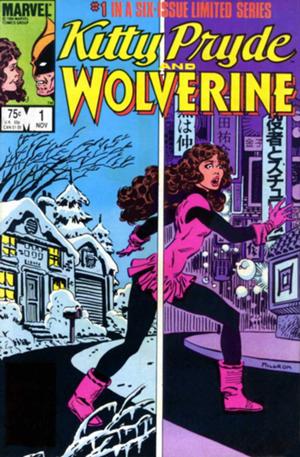
It not only represents Kitty's phasing power (she can walk through walls, don't you know), but also her adventure from suburban Chicago (well, Deerfield), to Tokyo. And check out that curvature of the road/path. Clever. It continues to use the element of a vertical line in the covers throughout the series, although to less good effect after #2 or #3.
So anyway, this is but our third visit to the "Wolverine's adventures in Japan" story-well, after the miniseries and the follow-up in Uncanny from #172 (well, excluding the brief trips in #119 and #181), and the best yet. It presents a somewhat less Orientialist view of Japan than those. This is the Japan of salarymen and shinkansen.
Kitty Pryde provides our in. She's in Chicago, having left the X-Men in #183 after Colossus dumped her. For her the saying that you can't go home again is literal - her parents have divorced in the interim (Is she the first superhero with divorced parents?)
Having run away to Chicago, she then runs away to Tokyo, on the trail of Yakuza bosses who are threatening her dad, Carmen. She finds herself well out of her depth, and is handed over by Shigematsu-san, to Ogun, a demonic ninja type, who uses his mind-control powers to brainwash her. But, before she'd been captured, she'd managed a phone call to Westchester, so Wolverine is on the way.
Wolverine (or "Mr. Logan" as he is called by the person at immigration who had seen his passport) catches up with Yukio (and very definitely adds a link to the Shag Chart - on a roof, even! We probably should have added this earlier, but who is keeping score?), and outlines the problem. He makes arrangements to pick Kitty up, but instead meets an ambush by Ogun-as-Kitty herself, who he eventually recognises the smell of. After some fighting Yukio rescues Logan, Kitty and Carmen, and they recuperate at a house owned by Mariko.
Kitty is sent home to New York, but doesn't make her flight, and instead returns to Tokyo to take revenge. She's grown up now, and discards the names Ariel and Sprite and Kitten, declaring that she's a Cat now, and rather prefers the shadows anyway.
She works her way up the foodchain, and eventually confronts Ogun, who she realises will be taking all this out on Mariko, Wolverine's former fiancee (and now foster-mother of Wolverine's foster-daughter Amiko from #181). But - thankfully - she can't make that killing blow. Wolverine takes it upon himself to the deed, to protect her. He is the best at what he does, after all.
The series manages a massive maturity upgrade for Kitty - from Ariel to Shadowcat, but the real loss-of-innocence moment is not that - or the mind control by Ogun. Instead, it's the realisation that her father was no innocent victim, but an exemplar of the principle that you cannot con an honest man.
Carmen is up to his neck in it. He eventually hands himself over to the authorities at the end, mind.
Wolverine, too, grows. He has responsibilities as a father figure for Kitty - this is arguably the start of him being paired with young women (if you don't include the previous team-up with Rogue) - and more directly as a foster father for Amiko, and we see here his unwillingness to let other other people - children in particular - but also to some extent Yukio - get their hands dirty for him. We also find out more about his past - he had met Ogun, and was trained by him - on his first visit to those islands, many years ago; before he had been taken in by the Hudsons and given a home in Department H. Since Ogun was unware of it, we can conclude that something happened in between: the adamantium, the becoming an animal. The seed, in other words, of Weapon X.
Subscribe to:
Posts (Atom)